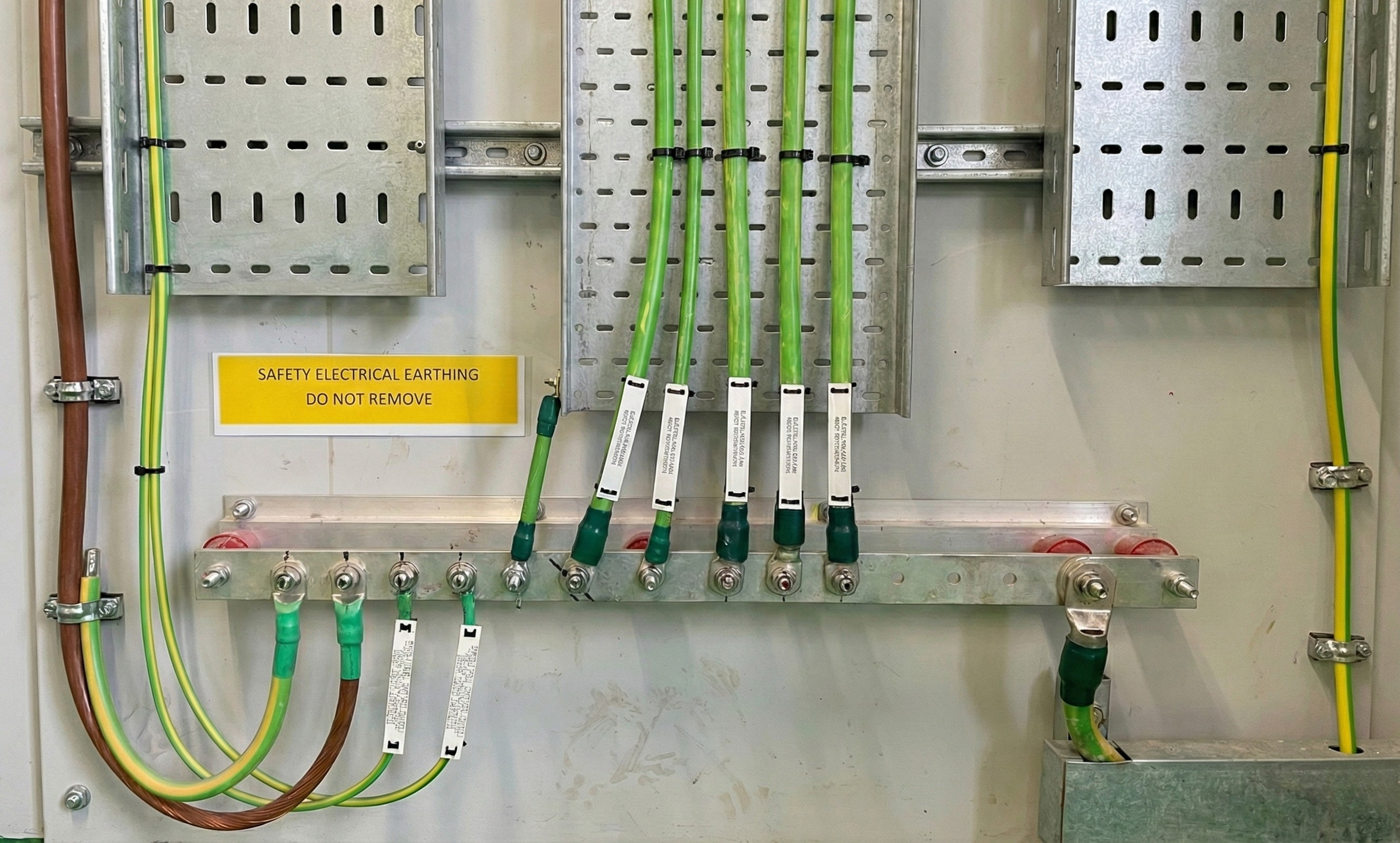
When we think of lightning protection, it’s common to focus on the lightning rod or its down conductors. However, much of the actual performance of the system depends on the grounding system.
But a grounding system for lightning protection has nothing to do with a conventional electrical grounding system. Its design must respond to a completely different phenomenon, one that is extraordinary in electrical terms: an extremely fast, intense, and high-frequency current.
In this article we explain why, from the physics of lightning, the grounding system must be specifically designed to ensure the safety of people, structures, and equipment.
What do we mean by grounding?
A grounding system is designed to establish a controlled physical connection between an electrical installation or protection system and the earth. Its purpose is to divert unwanted currents into the ground to prevent dangerous voltages and ensure the correct operation of safety systems. A well-designed grounding system allows you to:
- Prevent electric shock to people.
- Protect equipment and sensitive electronics.
- Activate protections such as residual-current devices and circuit breakers.
- Equalize electrical potential (equipotential bonding).
- Reduce the risk of electrical fires.
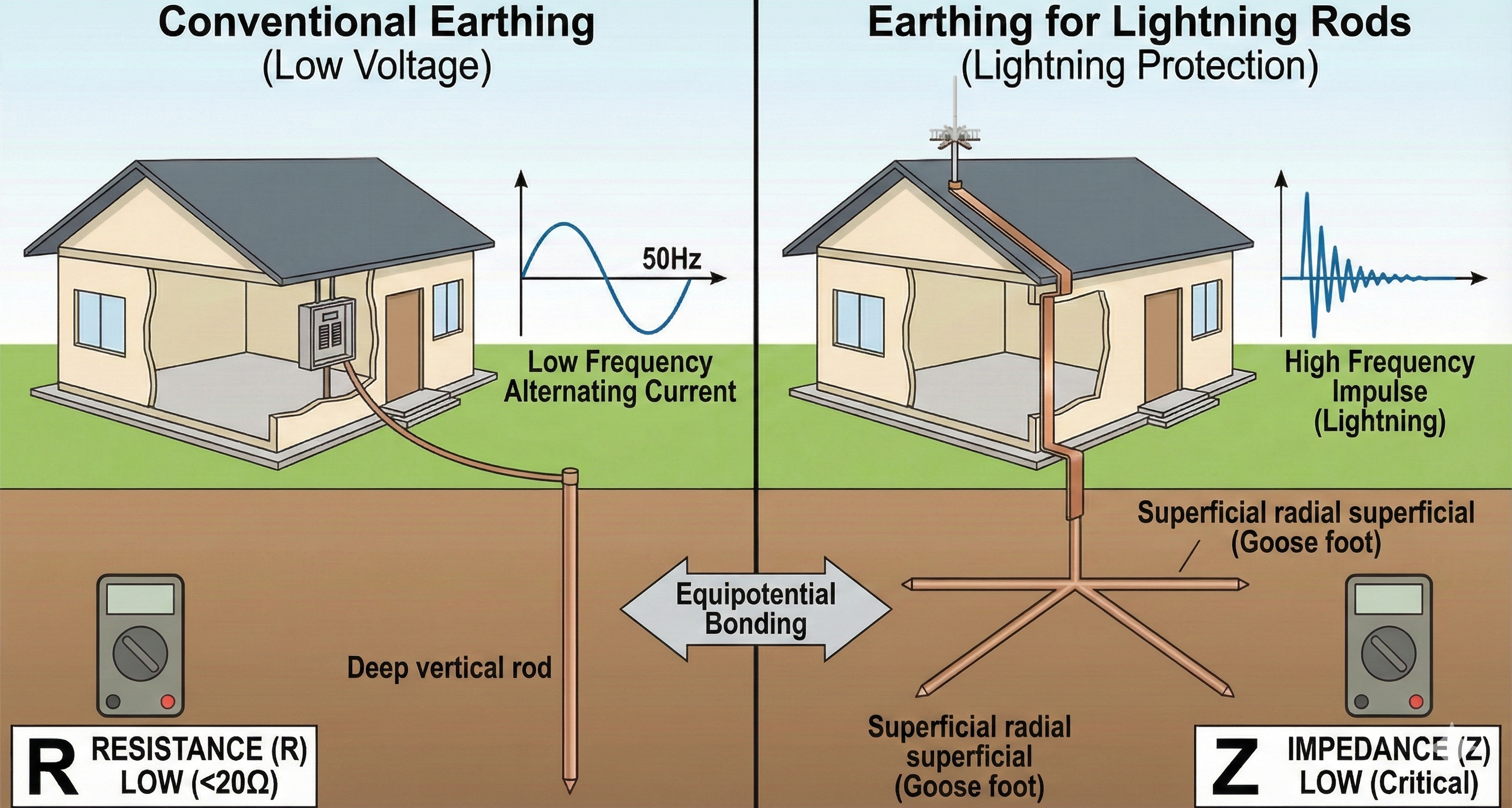
A lightning strike behaves in a way that’s more similar to a high-frequency impulse than to a direct or alternating current.
While an electrical installation operates at 50 Hz, a lightning strike:
- Can exceed 200,000 amperes.
- Reach several million volts.
- Develop a wavefront in microseconds.
This means that the lightning current contains very high-frequency components (on the scale of hundreds of kHz to MHz).
Design of a grounding system for lightning discharges
In such a fast pulse, the current tends to flow along the surface of the conductor, not through its interior. For this reason:
- Conductors must have a large contact surface, not just a large cross-section.
- Tight bends increase impedance and can cause arc jumps.
- Connections must be straight, short, and have wide radii.
For lightning, low impedance is far more important than low resistance in a grounding system.
In an electrical installation, low resistivity is always synonymous with a good ground. But for a high-frequency phenomena such as a lightning discharge, what matters is not only resistance, but impedance, which includes:
- Electrical resistance.
- Capacitance.
- And especially, inductance.
An installation may display excellent resistance… and yet still be unable to dissipate a lightning strike because its impedance is too high.
A typical example: A single 3-meter vertical electrode may measure 5 ohms (a low resistance value), but its performance when hit by a high-frequency impulse can be inefficient, forcing the current to seek alternative and dangerous paths.
Another key point: at high frequency, the lightning current does not penetrate deeply into the ground.
Dissipation occurs in the surface layers of the soil. This means that:
- A mesh or perimeter ring is more effective than only vertical rods.
- Distributing horizontal and vertical electrodes in a “crow’s foot” configuration allows the energy to spread over a larger area, reducing dangerous voltages.
This is why national and international lightning protection standards clearly recommend these types of solutions for buildings and large structures.
Equipotential bonding is the best way to avoid potential differences
When a lightning strike enters the ground, it creates a voltage drop in the soil that may reach thousands of volts between two points separated by only a few meters.
This can lead to hazards such as:
- Step voltage: difference in potential between a person’s feet.
- Touch voltage: difference between a point on the ground and a nearby metallic structure.
A poorly designed grounding system can allow these voltages to:
- Reach pedestrian areas.
- Enter sensitive equipment.
- Or generate arcs through metallic structures.
A physical grounding system for the lightning protection system that is equipotentially bonded to the building’s general grounding network reduces these gradients by distributing the current evenly and safely.
Conclusion
Grounding is an essential element for electrical safety and lightning protection. However, not all grounding systems are the same: Electrical grounding protects against internal faults, while lightning grounding protects against atmospheric discharges.
An incorrect design or the lack of knowledge on the differences between both types can create serious risks — from electric shock to structural damage or failures in critical equipment.
If you want to explore this topic further or learn about professional solutions, you can visit our grounding systems section, where you will find technical information, products, and specialized downloadable resources.
Do you need guidance to design or improve your grounding system?
At INGESCO, we specialize in lightning protection systems and professional grounding.
Our technical team can analyse your installation and recommend the best solution according to standards and project requirements.
Fill out the form and request a free consultation with our experts.